
Hiring in 2026 is no longer about whether to use AI.
It’s about how to use it well.
Artificial intelligence has made applying for jobs faster and easier than ever. Candidates can tailor resumes in seconds, and applications now arrive at scale. For employers, that has created a paradox: more volume, but less clarity about who can actually do the work and who genuinely wants the role.
At the same time, roles are evolving, budgets are tighter, and candidates are more selective about where they invest their time. The result is a hiring environment defined by high applicant volume, slower decision-making, and fewer meaningful human touchpoints.
The challenge for employers is not choosing between automation and people. It’s knowing where automation creates efficiency and where it quietly undermines hiring outcomes. The organizations that hire well in 2026 are deliberate about keeping human judgment in the moments that matter most.
For more than 15 years, through shifts in labor markets, capital cycles, technology, and work culture, Creative Alignments has helped fast-growing companies build teams that last. What we’re seeing now isn’t a temporary disruption. It’s a structural shift. Hiring practices must evolve with it.
Why Applicant-Based Hiring Isn’t Enough in 2026
Posting a job and waiting for the right people to apply has never been a reliable talent acquisition strategy. In 2026, this “post and pray” approach is especially ineffective.
Resumes and cover letters are easier than ever to optimize—sometimes by simply inputting a job description and having AI mirror it back. Many now look highly relevant on paper, even when the underlying experience or interest doesn’t align.
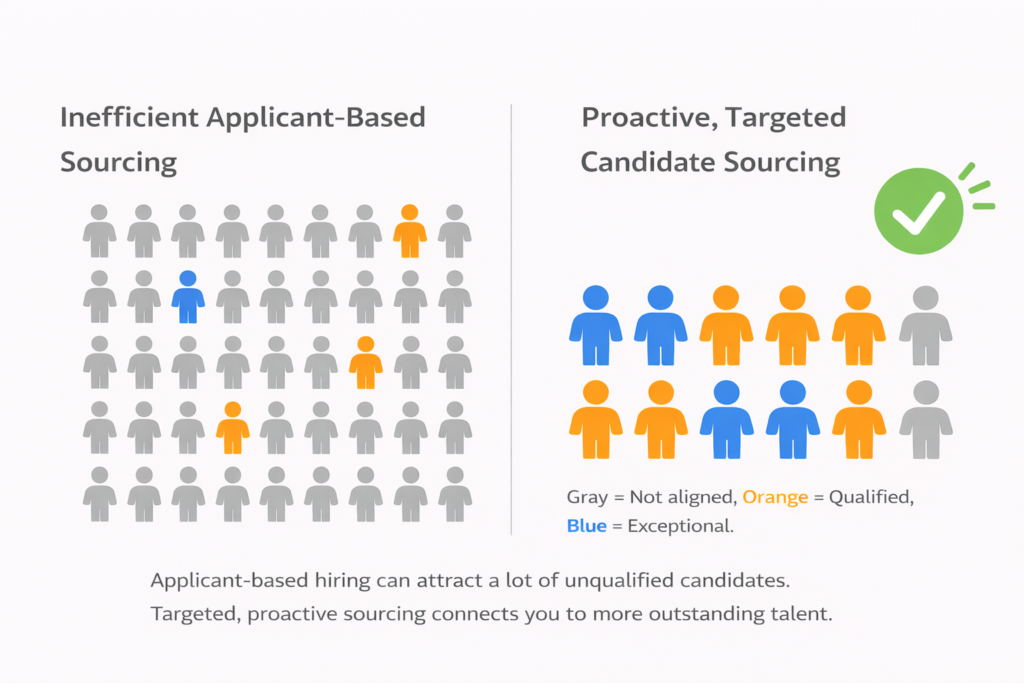
This dynamic has created what many hiring leaders describe as an “AI doom loop”: more automated applications leading to more automated screening, eroding trust and frustrating both employers and candidates.
Common challenges caused by applicant overload
- Recruiters spend more time filtering resumes than evaluating people
- Hiring decisions slow as volume creates a false sense of endless options
- Job scope, compensation, or requirements shift mid-process to accommodate market realities
- Strong candidates disengage in favor of employers with clearer, more human hiring practices and better communication
These challenges aren’t leadership failures. They reflect traditional recruiting practices colliding with a rapidly changing, AI-accelerated market.
The risk to employers is that highly qualified candidates often assume they won’t be seen in large applicant pools. “Applications disappear into the void and I never hear from anyone,” a candidate told us recently. Our recruiters hear this kind of thing regularly from really strong candidates.
The “AI doom loop” is not only eroding trust, but creating a sense of futility on both sides; candidates feel invisible while employers feel buried.
Proactive, Human Sourcing Gives Employers a Competitive Advantage
Chances are, your ideal candidate is not actively job hunting, and is certainly not applying. More often, they’re already employed and doing well.
Reaching them requires investigative work and real clarity about what success looks like in the role. Once you have that defined, you can focus on the individuals most likely to be your ideal hire.
Tap them on the shoulder to explore whether a conversation makes sense. The goal isn’t to sell a job. It’s to provide context that makes the conversation worth having and creates space to thoughtfully connect experience, motivation, and opportunity.
To increase the chances that an ideal candidate will engage with you, be prepared to talk about:
- why the role exists now
- why this person, specifically, stood out
- how the opportunity connects to where they are and where they may want to go
- how the company stands out as a place to do meaningful work with a respected team
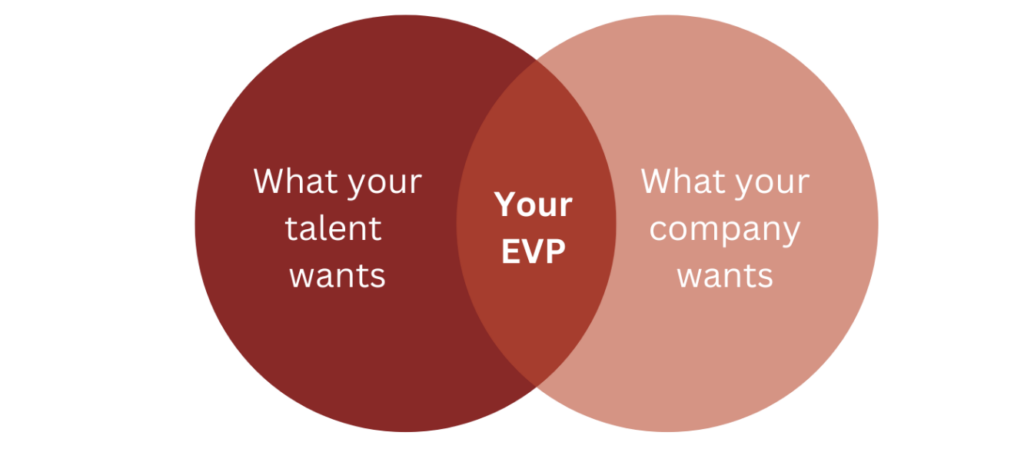
Candidates are evaluating employers just as carefully as employers are evaluating candidates. At this stage, over-automation works against you. Personalization, judgment, and genuine curiosity are what signal that the opportunity (and the employer) are worth exploring.
We regularly hear things similar to this candidate: “I don’t usually respond to recruiters but your outreach was so human and interesting I got excited about the opportunity.”
Leverage AI for Recruiting. Lead with Human Judgment.
Used well, AI can significantly improve efficiency. Used without clear intention, it can unnecessarily add noise and complexity.
To make up for more applicant volume and less relevance, many employers add assessments or additional steps in an effort to better understand who can actually do the work.
Assessments can be useful, but they are only one data point. Overused or poorly integrated, they can slow hiring, feel off-putting to strong candidates, and introduce evaluation standards that don’t always reflect how success is measured for current employees.
When hiring becomes too automated:
- candidates feel evaluated by systems instead of people
- communication slows or becomes convoluted
- authenticity and the person behind the resume becomes harder to assess
- processes feel transactional and impersonal
Maintaining a strong human layer (especially in early conversations and decision-making) is what differentiates employers in an AI-saturated hiring market.
“Using AI to polish a resume or cover letter is not inherently bad, but if someone can’t articulate their passions and values, or at least cue the LLM to sound like them, that’s an important piece of data to have about a candidate,” said Alexis Palmer, a long-time Creative Alignments recruiter.
Clarity Is Critical When Roles, Offers, and Hiring Decisions Are More Fluid
Hiring in 2026 is less linear. Roles shift mid-process. Compensation, scope, and priorities evolve. Senior candidates are weighing stability and benefits carefully, and they often have multiple options.
Fluidity isn’t the issue. Lack of clarity is.
We recently supported a long, thoughtful executive search search for a client. The recruiter did an exceptional job. The CFO candidate was strong. The client was thrilled. Everyone was ready to close.
But when it came time to extend the offer, key equity details hadn’t been finalized. The contract with the overseas parent company was still in progress. What should have been straightforward stalled and ultimately, the candidate accepted another offer.
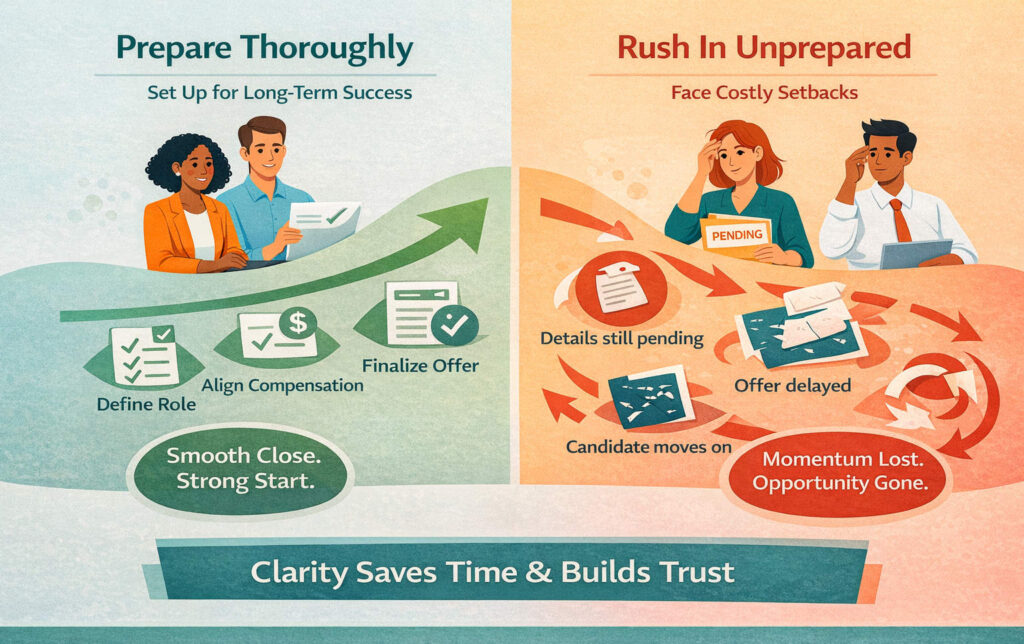
If you’re not fully ready to make an offer, you’re not actually ready to make an offer.
In today’s market, great candidates move fast. Preparation (compensation clarity, equity specifics, decision authority, finalized documents) is not administrative. It’s a signal of seriousness and respect. Without it, even the best search efforts can unravel at the finish line.
Candidate Experience Directly Impacts Hiring Outcomes
Candidate experience is no longer a “nice to have.” It affects offer acceptance rates and how candidates feel heading into, or walking away from, the process. Even when the answer is “no,” candidates remember how they were treated and often share that experience with others. How people talk about your company as an employer has a real impact on referrals and reputation, not to mention how long they choose to stay at your company. The old adage rings true here: You never have a second chance to make a first impression.
Some of the strongest employer brand impressions come from candidates who felt respected, informed, and clearly communicated with throughout the process. And when even those who didn’t get the job feel good about the experience, it strengthens your reputation as a place people want to work, making your recruiting easier.
And it is not just your recruiting process, but who you put on the front lines to represent your company to your candidates. Something we hear from our Creative Alignments’ clients often is how much we have improved their candidate experience with everything from process, interviews, communications, and brand representation.
The Opportunity for Employers in 2026
It’s important to keep in mind that as AI gets better at mimicking humans, humans are getting better at spotting AI.
The opportunity in 2026 is not to automate more.
It is to automate thoughtfully, and reinvest time and attention into the moments that build trust, clarity, and long-term alignment.
How to Hire Better Candidates in 2026
- Define success before you invest time in the search
Before posting a job or sourcing candidates, go beyond a list of skills and years of experience to also identify the combination of behaviors, capabilities, and ways of working that will lead to strong performance in this role and within your company.
Be explicit about true must-haves vs. nice-to-haves, where you can be flexible and what tradeoffs you are willing to make. This clarity prevents mid-process shifts and keeps the search focused. - Proactively seek out people already doing the work well
The candidates most likely to succeed in your role are often already succeeding in similar roles elsewhere. They are rarely applying to jobs, and likely want upward mobility, not lateral moves.
It takes some detective work to find these candidates, but once you do, tap them on the shoulder and connect the dots between their experience, goals, and needs, and your opportunity. Roughly 90% of the hires we make for clients come from this type of proactive, targeted search rather than applicant pools. - Clarify your employer value proposition (EVP)
Before reaching out, be able to clearly answer: Why would a strong candidate want this job at this company?
Candidates are evaluating employers just as carefully as employers are evaluating candidates. Your EVP should speak honestly to the work itself, the team, leadership and company culture, growth opportunities and professional development, stability, benefits, and flexibility. This context is what makes a conversation worth having. - Use targeted, human outreach to spark interest
Outreach should be personal, relevant, and transparent, which sets you apart in a market flooded full of automated messages. The goal isn’t to persuade. It’s to invite a conversation.
Effective outreach includes clear context about the company and role, why this person stood out specifically, an invitation to have a conversation vs. a sales pitch and respect for the fact that strong candidates are often already employed and selective. - Use job postings for clarity, not as your primary sourcing strategy
Job postings still matter, but their role has changed. Treat them as a tool for clarity, credibility, inspiration, and alignment, not the primary way you’ll find your best candidates.
When postings clearly articulate the role, expectations, and value proposition, they support proactive sourcing rather than replace it.
Why This Works
This approach shifts recruiting from sorting applicants to building relevance and trust from the start. It is a targeted way to shorten time to hire, and consistently attract candidates who are both capable and genuinely interested.
How to Reduce Time-to-Hire and Avoid Losing Strong Candidates
Long timelines, unclear decisions, and shifting expectations quietly disengage strong candidates. Reducing time-to-hire isn’t about rushing. It’s about clarity, alignment, and momentum to keep people interested and in the mix.
1. Align internally before launching the search
Before candidates enter the picture, internal stakeholders should be aligned on what success in the role actually looks like, which requirements are truly non-negotiable versus flexible, and where tradeoffs are acceptable if the market doesn’t deliver a “perfect” match.
Misalignment at the start almost always shows up later as delays, second-guessing, or role changes mid-process. These create uncertainty for candidates and extend time-to-hire.
2. Set expectations upfront around process and timelines
At the beginning of the process, clearly outline interview stages and who candidates will meet, expected timelines between steps, and how and when decisions will be made.
Clear timelines and next steps reduce uncertainty and help candidates stay engaged rather than hedging with other options.
3. Communicate changes clearly and early
Roles evolve. Compensation bands shift. Location requirements change. These adjustments aren’t inherently problematic, but how they’re handled matters. When changes occur, communicate them immediately to candidates in the mix, explain the rationale, and reset expectations clearly.
Late or unexplained changes slow decisions and erode trust. Clear communication preserves momentum and keeps strong candidates engaged.
4. Do decision-making work early so you can move quickly later
Many hiring delays happen after the right candidate is identified. To avoid that, get aligned before interviews begin. For instance, align on compensation ranges and approval authority, offer components and flexibility (including approved equity, if relevant), decision criteria, and who has final say.
When these decisions are deferred, momentum is lost at the most critical moment, when candidates are comparing options and counteroffers are most likely.
5. Audit and streamline your application and interview process
Every step in your hiring process should earn its place. Be intentional about how many interviews are truly necessary, whether assessments are role-relevant and fairly applied, where scheduling or handoffs cause delays, and whether current employees in similar roles would pass the same process.
Overly long or complex processes disproportionately drive away the strongest candidates, who often have other options.
6. Treat candidate experience as a core hiring lever
Candidate experience is not separate from hiring speed. It directly affects it.
What consistently improves candidate experience are clear timelines and next steps, timely, human communication, prepared and aligned interviewers, and respectful, timely closure so candidates can move on. This builds trust so they stay engaged longer, make decisions faster, are more likely to say yes, or to speak well of your company even if the answer is no.
Frequently Asked Questions About Hiring in 2026
How is AI changing recruiting in 2026?
AI isn’t the first technology to reshape recruiting, but it’s the fastest-moving.
Over the past 30 years, hiring evolved from classifieds to job boards, from manual resume review to applicant tracking systems, and from reactive posting to proactive sourcing through digital networks. Each shift increased scale and efficiency.
But many hiring systems still rely on two outdated assumptions. First, resumes accurately reflect capability. Second, strong candidates will apply and wait.
AI disrupts both. It makes it easier to apply, but harder to assess alignment.
The organizations struggling in 2026 aren’t necessarily behind on technology. They’re running hiring systems designed for a different era, built to process applicants, not recruit talent.
The shift now is strategic, not technical.
The companies that hire well use AI to remove administrative friction, proactively identify and engage the right candidates, rely on human judgment where motivation and alignment matter, and run clear, decisive processes that respect how quickly strong candidates move.
AI is changing recruiting rapidly. The systems will keep evolving, but the constant remains the same: hiring still depends on human discernment, connection, clarity, and trust.
How should we use AI in hiring without losing the human element?
AI works best as a support tool, augmenting human judgment rather than replacing it.
Most applicant tracking systems and recruiting platforms now have AI-powered recruiting platforms embedded in them, from resume screening and candidate ranking to outreach suggestions and interview support. For many organizations, AI isn’t a separate add-on anymore; it’s built into the infrastructure of how hiring happens.
The key question isn’t whether to use AI. It’s where. Use AI to streamline scheduling and administrative work, organize and surface data, improve job description clarity, assist with sourcing research
But keep humans accountable for early conversations and relationship-building, interpreting nuance beyond the resume, assessing motivation, judgment, and cultural alignment, final hiring decisions
There is also increasing legal scrutiny around automated decision-making in hiring. Regulators and courts are examining how AI tools may introduce bias or unfairly screen out candidates. Yet another reason to ensure human oversight remains central.
AI can increase efficiency. It cannot evaluate trust, chemistry, or long-term team impact. The employers who stand out in 2026 are those who automate thoughtfully and reinvest their time where human judgment matters most.
How do we reduce applicant overload caused by AI-generated resumes?
The solution isn’t more filtering, it’s smarter sourcing.
Major job platforms have reported significant increases in application volume over the past year, with thousands of applications submitted every minute. More volume does not equal more qualified candidates. It often means more noise.
To reduce overload, define success clearly before launching the search. Focus on the behaviors and capabilities that drive performance. Proactively identify and reach out to candidates already demonstrating those traits, and treat job postings as visibility tools instead of your primary sourcing strategy.
When you shift from sorting applicants to targeting ideal profiles, volume becomes less overwhelming and quality increases significantly.
Are hiring assessments still effective in an AI-driven hiring market?
Assessments can be valuable, but only as one data point.
As AI makes resumes more polished and uniform, some employers add assessments to better differentiate candidates. While this can provide insight, overuse or poor integration can slow hiring timelines, frustrate strong candidates, and create evaluation standards that don’t reflect real-world performance.
The most effective assessments mirror the actual work (e.g. structured exercises, simulations, or case discussions directly tied to the role) and are paired with thoughtful interviews because they work best as a complement to human evaluation, not as a substitute for it.
If your current high-performing employees wouldn’t pass the process today, it’s worth reassessing how it’s designed.
How do we design a hiring process that attracts and engages high performers?
High performers move quickly, and they usually have options.
In 2026, clarity and preparation are competitive advantages. To attract and retain strong candidates in your process, align internally before launching a search, finalize compensation, equity, and approval processes early, clearly communicate timelines and next steps, keep interview stages purposeful and streamlined, ensure interviewers are prepared and aligned, and provide timely, respectful communication even when the answer is no
Think about it this way: Preparation signals seriousness. Clarity signals competence. Respect signals culture. In a market where top talent often weighs multiple opportunities at once, a streamlined, human-centered hiring process is not just good practice. It’s a differentiator.
How is AI changing recruiting in 2026?
AI isn’t the first technology to reshape recruiting, but it’s the fastest-moving.
Over the past 30 years, hiring evolved from classifieds to job boards, from manual resume review to applicant tracking systems, and from reactive posting to proactive sourcing through digital networks. Each shift increased scale and efficiency.
But many hiring systems still rely on two outdated assumptions. First, resumes accurately reflect capability. Second, strong candidates will apply and wait.
AI disrupts both. It makes it easier to apply, but harder to assess alignment.
The organizations struggling in 2026 aren’t necessarily behind on technology. They’re running hiring systems designed for a different era, built to process applicants, not recruit talent.
The shift now is strategic, not technical.
The companies that hire well use AI to remove administrative friction, proactively identify and engage the right candidates, rely on human judgment where motivation and alignment matter, and run clear, decisive processes that respect how quickly strong candidates move.
AI is changing recruiting rapidly. The systems will keep evolving, but the constant remains the same: hiring still depends on human discernment, connection, clarity, and trust.